Basic Simulation
The starting point: immersive environments with guided training workflows, pass and fail validation, and basic reporting. Ideal for safety orientation, site familiarization, and hazard identification.
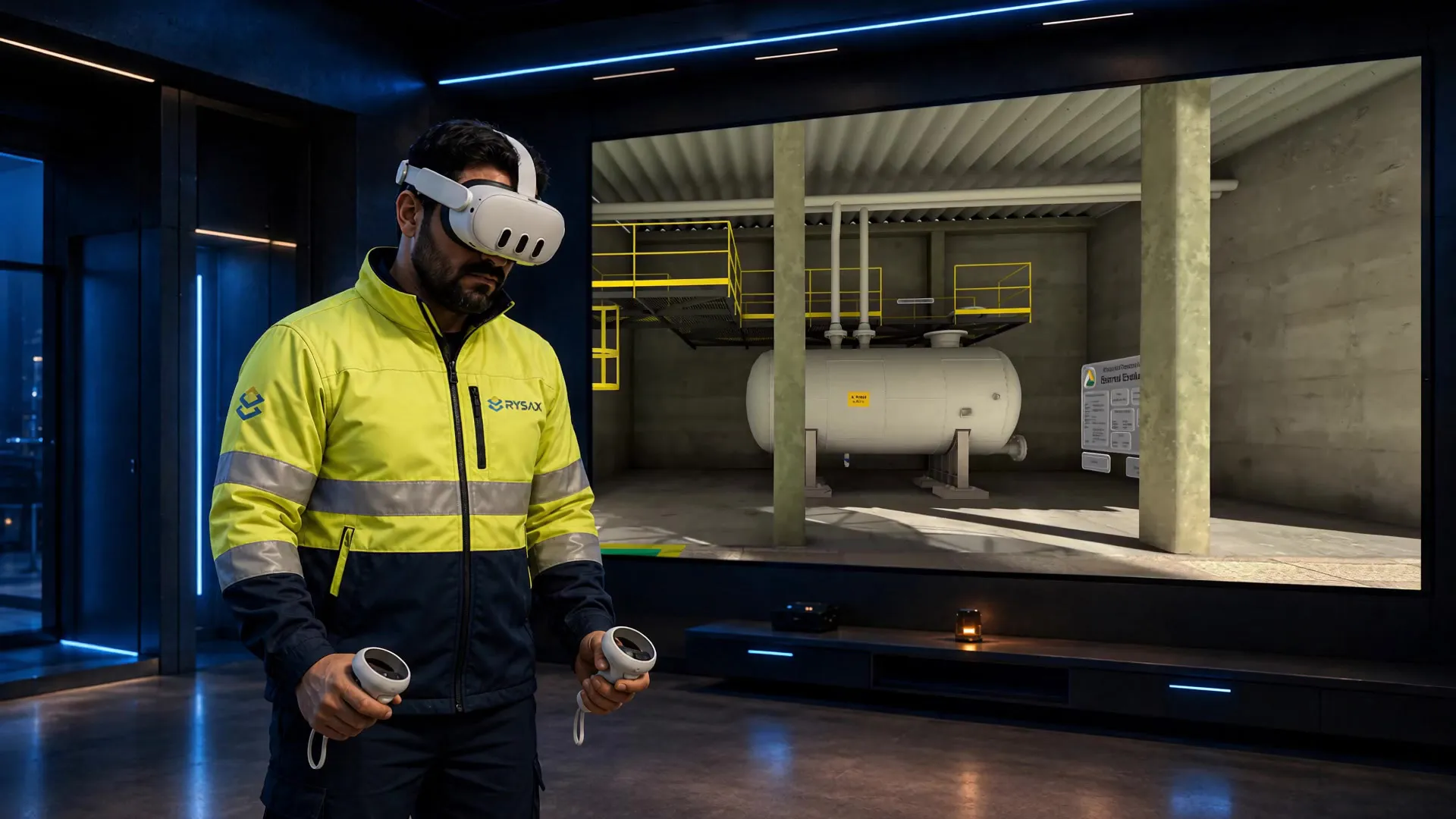
Zero risk in training. Zero fear in execution.
Rysax builds award-winning, hyper-realistic VR simulators that recreate your site, your equipment, and your procedures, so your teams master critical operations before they ever face them live.
Up to 80% of industrial accidents involve human error. Not equipment failure, not design flaws: people who were not adequately prepared for the moment they faced.
The issue is not a lack of effort. It is a structural limitation of how training is delivered today. The scenarios that matter most, process deviations, emergency shutdowns, equipment failures under pressure, are exactly the ones too dangerous to practice in real life. Access to real equipment for training is limited, expensive, and operationally disruptive. And classroom instruction cannot replicate the complexity of a live industrial site.
So teams train on theory. And then they face reality for the first time in the field.
The cost structure makes it worse. Of the 98 billion dollars US companies spent on training in 2024, roughly one dollar in four went to travel, facilities, and equipment rather than instruction: money that moves people toward the training instead of training them, often far from the equipment they actually operate.
Then the trained people leave. US manufacturing loses workers at a pace equivalent to nearly a third of its workforce per year; in construction it is closer to half. Replacing one skilled worker costs from a third up to two times their annual salary, and every departure resets training to zero.
And the clock is ticking on something turnover makes even worse: tribal knowledge. Procedures capture what to do. Experience carries the rest: how the unit really behaves under stress, what that sound means, the small adjustments that make a procedure work in the real world. That knowledge lives in your most experienced people, and with roughly one in four workers in US heavy industry already 55 or older, it is walking out the door, and no manual can capture it on the way out. In US manufacturing alone, 2.8 million job openings are projected to come from retirements by 2033, and 1.9 million of the jobs needed are expected to go unfilled.
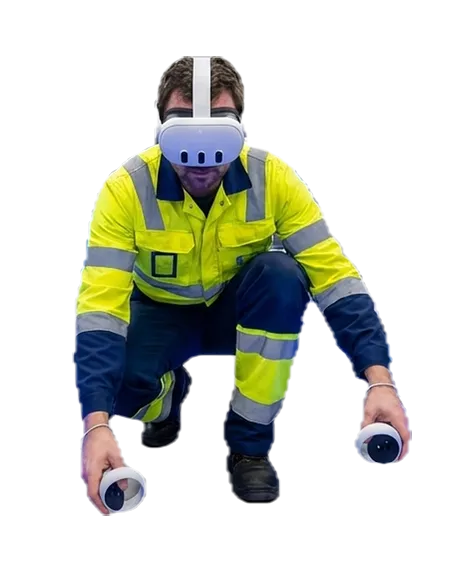
Rysax Hyper-Realistic Immersive Training covers the full spectrum of industrial training simulation. It starts simple: guided scenarios built from your procedures and reference materials, running on commercial headsets and ordinary computers, deployed without touching your operation. And it climbs as far as your program needs to go: your real areas laser-scanned into the simulator, engineering-grade 3D modeling, gaming-studio realism, and, at the top, physical control panels replicating your real equipment.
Wherever you enter, the discipline is the same. Every project ships in two forms, the immersive VR simulator and a Windows desktop version of the same training, so every professional, every site, and every budget has a way in. And inside it, your teams can do what no site would ever allow: fail safely. Repeat the critical maneuver twenty times. Trigger the emergency. Practice the shutdown until it is boring.
Train without risk. Repeat without operational impact. Learn from failure before it happens in the real world.
The Worldsteel Steelie Award 2023: Excellence in Education and Training. The continuous casting operations simulator our team developed in partnership with Ternium took the global steel industry's recognition for training excellence, awarded by the World Steel Association, in an industry that runs some of the most dangerous operations on earth.
The same team has delivered simulators across heavy industry, from onboarding programs to emergency response, in environments where a training mistake in the field costs far more than any training program.
Every tier delivers both a VR simulator and a Windows desktop version, in the languages your workforce needs, on a subscription that keeps scenarios current.
And the ladder is the point. Many industrial VR initiatives stall as impressive pilots that never become programs. The tiers exist so yours does not: start at the level your operation needs today, prove it against your own metrics, and step up without starting over.
The starting point: immersive environments with guided training workflows, pass and fail validation, and basic reporting. Ideal for safety orientation, site familiarization, and hazard identification.
Interactive equipment operation, procedural scenarios with decision points, and performance scoring. Built for start-up and shutdown procedures, maintenance workflows, and lockout-tagout.
Complex systems, dynamic process scenarios, and instructor-controlled simulations, optionally built on laser scanning of your real areas for full site fidelity. Made for emergency response, process deviations, and shutdown preparation.
The complete program: a full-site digital twin with physics-based equipment behavior, multi-role training, AI-driven feedback, optional physical cockpits, and multi-site deployment.
Enter your details and receive our VR Training Investment Guide: what each tier includes, what drives the investment, and where programs like yours usually start.
Unlock the investment guideNo. Tiers 1 and 2 are built from your procedures, reference materials, and site imagery, starting today, no scanning required. Laser scanning enters as an option at Tier 3, and the full digital twin defines Tier 4. And when a digital twin of your site exists, or when we build one in parallel, your teams train inside a faithful replica of their own unit: the same platforms, the same valves, the same escape routes they will use in real life.
Every scenario measures performance: automatic scoring, decision tracking, and readiness assessments per person. You define what “ready for the job” means; the simulator measures every professional against it. You see who is ready, who needs another run, and how the whole team evolves, with records that stand up to audits.
Training results, scores, and readiness records live in the platform and can be exported. Integration with your LMS (learning management system) is available as an option, scoped during deployment.
No. It arms them. VR takes the scenarios that are too dangerous, too rare, or too expensive to stage in real life; classroom and field training keep their roles. And from Tier 3 up, instructors control the simulation live, triggering failures and escalating scenarios, which makes your most experienced people the ones running the program, not the ones replaced by it.
We build the training; we do not sell hardware. Simulators run on commercial VR headsets you can buy anywhere, and we recommend the right setup for your scale, with no lock-in. And every tier includes a Windows desktop version that runs on ordinary computers, with no headset at all.
Yes. Scenarios are guided, the learning curve is minutes, and the desktop version gives hesitant users a familiar way in. Field workers tend to be the fastest adopters, not the slowest.
Custom, by design. Every simulator is built from your procedures, your equipment, and your scenarios, because generic training content produces generic behavior, and in critical operations the details are the training. Elements proven in earlier programs accelerate the build, but what your teams train on is your operation, not an approximation of it.
That is the design. The subscription model exists so your program grows: new scenarios, new equipment, new sites, without starting over.
Your scenarios change with them. Industrial sites do not stand still: procedures get revised, equipment gets replaced, layouts change. A simulator that still shows last year's procedure is worse than no simulator, because it trains the wrong behavior. Keeping scenarios current is part of the subscription, not a new project.
No. The subscription is the model most programs get the most from: it keeps scenarios current, spreads the investment, and lets the program grow without new procurement rounds. But organizations buy in different ways. If your company works on a per-project basis, we structure the engagement that way, with scenario updates contracted as you need them.
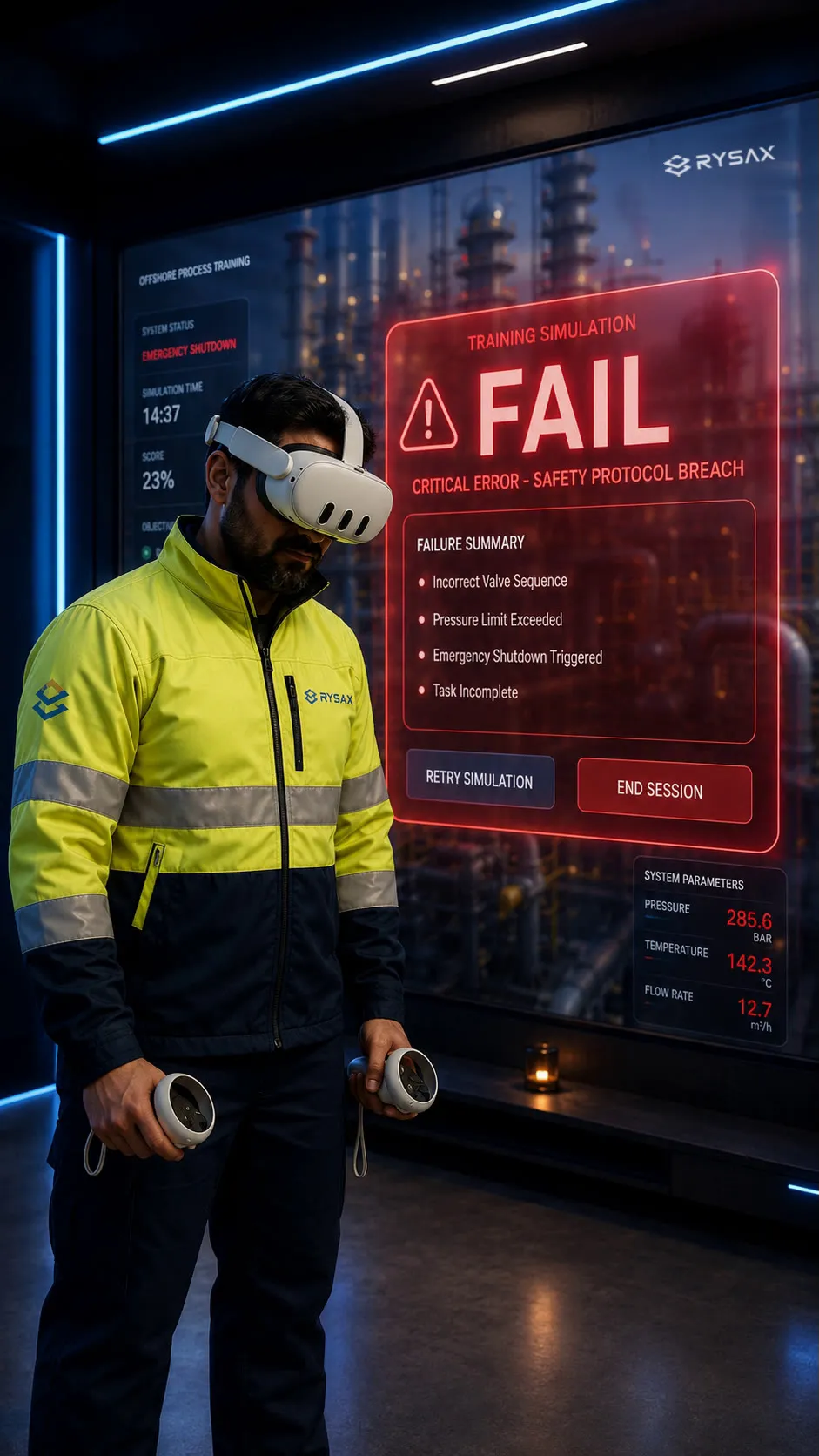
Book a demo and see the simulators for yourself, headset on. Bring your hardest training problem: a procedure, a scenario, a unit. We will show you what it looks like in VR.