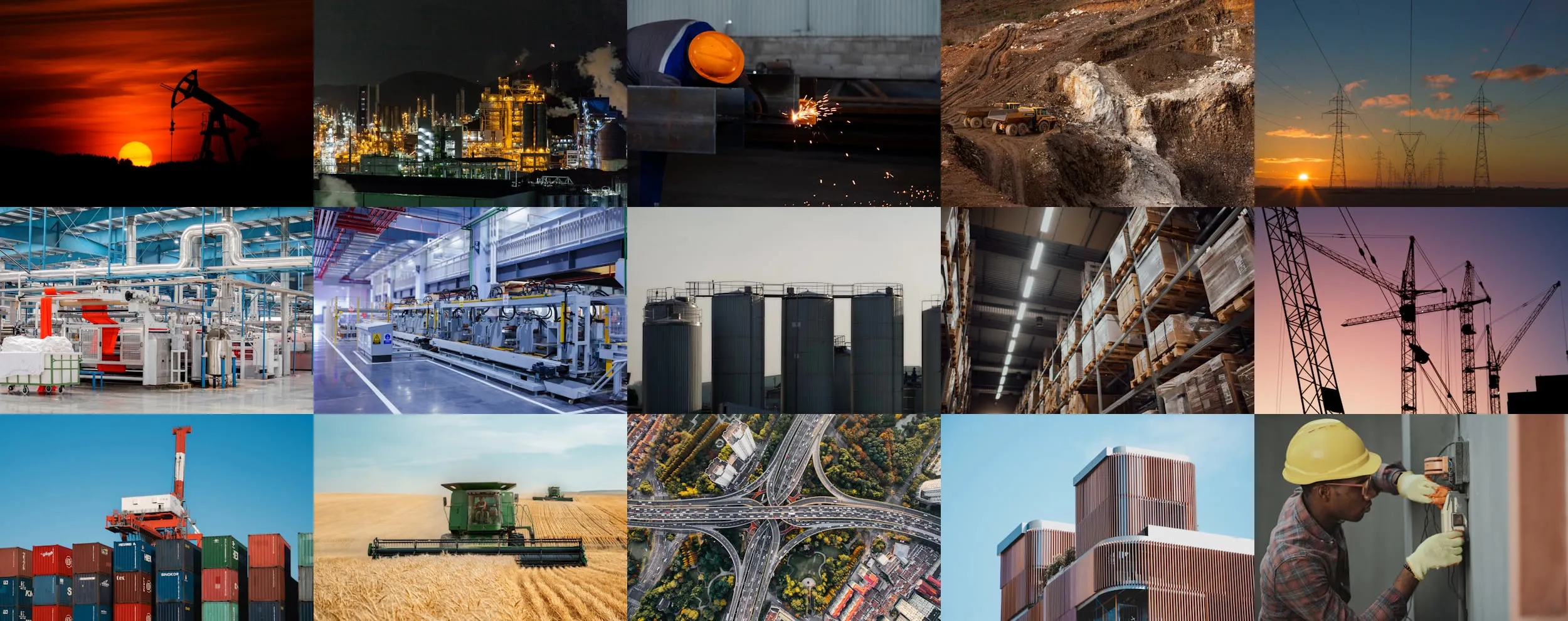
Heavy industry is our home.
The industry changes, the equipment changes, the physics do not: reality captured with millimetric precision, understood in context, and put to work in operations, inspection, maintenance, and safety.
- Oil & Gas
- Chemicals & Petrochemicals
- Metals & Steel
- Mining
- Energy & Utilities
- Pulp & Paper
- Manufacturing
- Food & Beverage
- Consumer Goods
- Construction & EPCs
- Logistics & Terminals
- Agribusiness
- Infrastructure
- Architecture
- Industrial Services
We did not arrive in heavy industry. We came from it.
Rysax was built by people who spent their careers inside the industries we serve. Our leadership and board bring together executives and engineers from steel operations, industrial coatings, oil and gas, and heavy engineering, and the Technofink Group behind us has served asset-intensive industry for more than thirty years. When our teams walk into a unit, they know the permits, the standards, the shift routines, and the cost of a mistake, because they have lived them.
That experience shows in projects our team has delivered across five continents, in multiple languages, and in award-winning simulators built for some of the hardest operating environments on earth.
- Team project experience on five continents
- Worldsteel Steelie Award 2023
- 30+ years of group heritage in asset-intensive industry
- Backed by the Technofink Group.
A sample of the experience.
A few projects that show how the discipline lands in each sector. Not the archive: here, you might recognize your world in ours.
Metals & Steel
Where our simulators beat the world.
Steel runs some of the most dangerous operations on earth, and it is where our team earned its hardest proof. At Ternium, mixed-reality training moved operators from the classroom into immersive, high-engagement simulation, and the continuous casting simulator our team developed in partnership with them won Worldsteel's 2023 Steelie Award for Excellence in Education and Training. At ArcelorMittal, simulators developed by our team replaced a training routine that used to interrupt production and consume raw material, and we scanned operating equipment to deliver updated models with documentation in the BIM framework, while the unit kept running.
Oil, Gas & Terminals
Precision where the stakes are highest.
At Petrobras refineries, our team captured entire process areas. In one unit, the full blowdown area became an as-built 3D model feeding rigging-study animations, so heavy lifts are planned on reality instead of memory. In another, scanning supported detailing engineering, with virtual tours captured through infrared-enabled imaging so engineering teams extract measurements and equipment data from a desk: fewer permits, fewer trips into the unit. And at a Stolthaven terminal, our as-built models of storage tanks fed finite element analysis, confirming safe operation with engineering-grade evidence.
Chemicals & Petrochemicals
Documentation that keeps up with the site.
At BASF, we scanned a process building across every elevation, a region the client's own team calls extremely dense and hard to access, to support the engineering department through an isometrics update: inspection-ready documentation, fewer site visits, and drawings that match the field again. Work for major petrochemical operators, Braskem among them, runs on the same foundation: scanning, modeling, and documentation in congested, live process areas, executed without touching the operation.
Manufacturing & Consumer Goods
The same rigor, at production speed.
At P&G, we scanned a packaging area and delivered virtual tours that gave teams remote access to the unit during work-safety processes: fewer people on the floor, the same visibility. Manufacturing and consumer goods sites use the same capture-to-model pipeline to plan line changes, document as-built conditions (supporting engineering work across project phases), and train operators without stopping production.
EPCs & Engineering Firms
Built to be built from.
Engineering firms and EPCs use our 3D scans (point clouds) and 3D models as the ground truth their designs stand on. At a fuel terminal project for a major construction group, we scanned existing pipe supports and corrected the 3D model against the point cloud, so supports flagged as clashing with civil structure were repositioned on the model, before anyone installed them wrong in the field. Point clouds, as-built models, BIM, and 2D deliverables, in the platforms engineering teams already use, at a pace and price built for project work.
Tell us which unit, which asset, which problem.
Talk to a specialist who has worked your industry. Real people, real field experience. No chatbots.