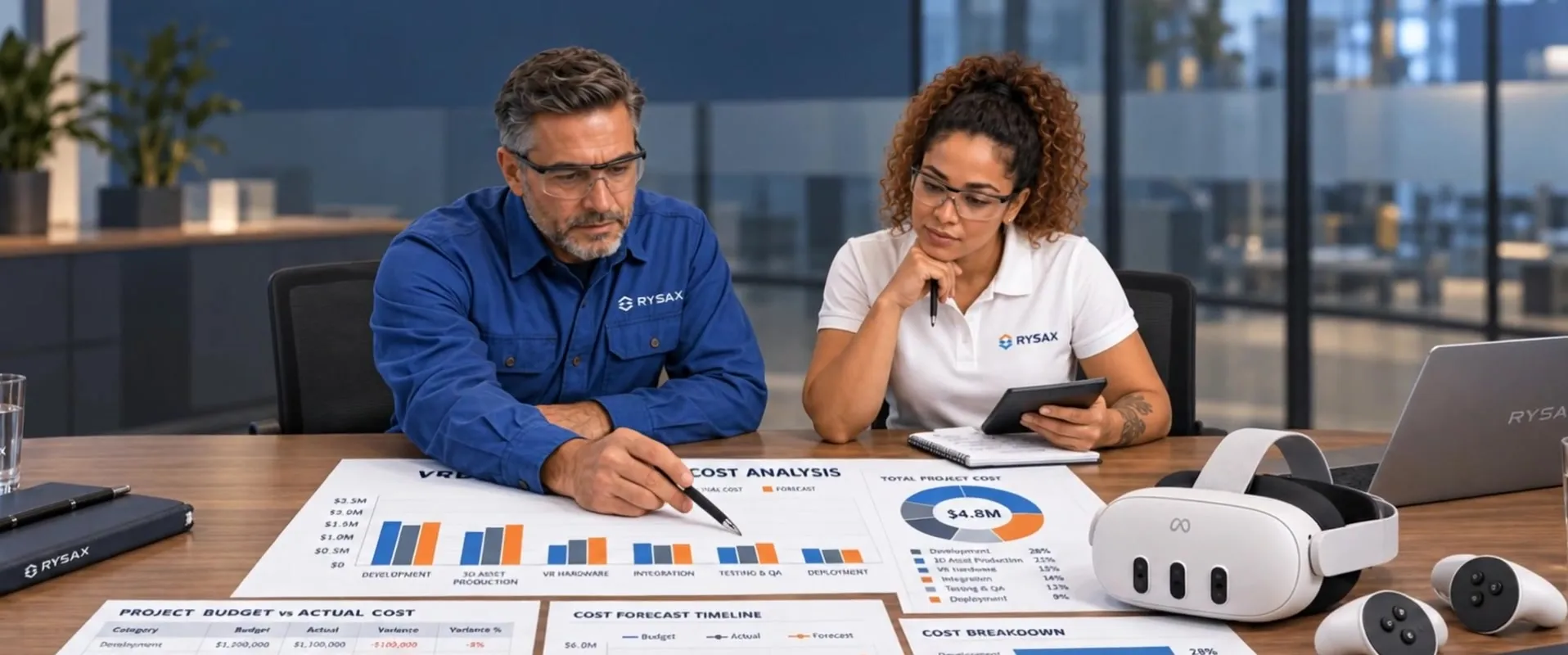
What VR training costs, and when it pays off
The cost of a Virtual Reality training program is driven by two factors: the platform tier you subscribe to and the content tailored to your operation. Here is how both behave, what the research does and does not tell you, and where programs waste money.
1. Where the cost comes from
VR training pricing has two components, and they behave differently.
The first is the platform: the tier you subscribe to, from Basic Simulation to Enterprise Digital Twin. The first three tiers are productized, and their reference figures exist by region. We share them through the Investment Guide. The Enterprise Digital Twin tier is scoped per operation, because your operation is not someone else's.
The second component is content, and this is the one no vendor can quote blind: how many procedures must be simulated, at what fidelity, on which equipment, measured against what definition of "ready for the job." A single generic safety walkthrough and a full operating-crew program for a continuous casting line are different purchases in every way except the headset.
This guide gives you the structure of both: what you are paying for, what the research does and does not tell you, and where programs waste money. With that, any quote you receive, from us or anyone else, becomes something you can interrogate.
2. What you are actually buying
Content is the engine of cost.
Developing immersive training content requires several disciplines to work together: instructional design, 3D modeling of your equipment and environment, simulation logic, and scenario design that determines what a trainee can do wrong. That work is what you are paying for, and it buys the thing the classroom cannot do: practice at zero risk. Imagine if commercial pilots didn’t have flight simulators to practice what they learn in classrooms. In heavy industry, not all equipment has a backup when it fails. VR training payback is huge, and it goes beyond dollar figures.
Fidelity where it matters. Cost balloons when a program is poorly specified. What drives learning outcomes is fidelity on the dimensions that drive behavior: the procedure logic, the instrumentation, the failure responses. A disciplined scope is what makes the training accurate.
The platform and the people. Delivery platform, deployment, instructor and administrator training, and support. This is where a training project becomes a training program.
Devices are a separate line. We do not sell VR hardware, and we recommend budgeting for it separately, following your vendor's guidance (we can help with that). Two structural notes from the field: a batch of devices carries its own logistics (charging, hygiene, updates, IT security), and a desktop-delivered version of the same scenarios removes that entire tail for the users who do not need immersion. The two work side by side, not one instead of the other.
Keeping it current. Procedures change. A simulator that trains an outdated procedure is not helpful: it builds the wrong reflexes, what researchers call negative transfer (Frontiers in Virtual Reality, 2021). And procedures are not the only thing that moves. VR hardware generations turn over fast, and a simulator locked to a discontinued headset quietly expires with it. As hardware evolves, our simulators evolve with it under the same subscription. Content and platform currency are recurring costs in any honest model, whether they are charged as a subscription or as support and maintenance.
3. What the research supports, and where the real numbers come from
Start with what the research does establish.
In a controlled enterprise study, VR learners trained up to 4x faster than classroom peers and were 275% more confident applying what they learned (PwC). Peer-reviewed work points the same way in tasks much closer to industrial procedure: a systematic review found immersive training comparable or superior to traditional methods in aviation, surgery, driving and assembly work, with reduced error rates, while naming the real limits, including motion discomfort, the absence of touch, and negative transfer when a simulation misrepresents the task (Frontiers in Virtual Reality, 2021).
The largest number in the calculation is one only you have. What no study can hand you is the number that actually decides the case, because that number is yours. What an unplanned trip of your unit costs per hour. What your last serious incident cost in full, including the investigation and the weeks after it. What happens when the equipment that fails has no spare on site. If you don’t know those figures, you should be able to have them quickly. An honest business case for industrial VR starts there and works down, rather than starting from a cost per learner and working up.
Be precise about what the alternative actually is. If the classroom can deliver the same training, comparing cost per head is a fair and worthwhile discussion. Where the scenarios that matter most are precisely the ones it cannot deliver, there is no comparison to run at any headcount. The choice is not between cheaper practice and dearer practice. It is between practicing and not practicing.
The logistics cost is current, and there is a way to save it. Training time is a scarce resource, and much of it is spent before anything is taught: travel, per diem, a crew off station, a room booked, an instructor mobilized, and almost always far from the field. US companies spent 98 billion dollars on training in 2024, and roughly one dollar in four went to travel, facilities and equipment rather than learning (Training Magazine, 2024; the share is derived from published figures). None of that shrinks because your operation is small: a crew sent to a training center costs what it costs. Training delivered where people already are is a real line in the business case.
And check how the license is counted. The per-head arithmetic behaves differently depending on how a vendor licenses. The ideal scenario is per-site, with unlimited users, so the cost per trained person decreases as more of your workforce runs the same scenarios, rather than climbing with headcount. Worth checking in any quote you compare, ours included.
Scale changes the argument, not the need. This matters most for smaller operations, where the case is made on entirely different grounds. A site with 30 people does not buy immersive training to beat the classroom on a cost-per-head basis. It buys it because the risk does not scale down with headcount: the emergency that closes a small operation is the same emergency a large one absorbs, and the knowledge walking out the door is proportionally more concentrated. One retirement from a team of 30 is a bigger loss of experience than one from a team of 100.
4. Where the money dies
Most VR training money is not lost on headsets.
It is lost on programs that stall. The demo that impresses leadership and often never becomes a program, because the pilot was designed to prove the technology rather than a business case. The bespoke simulator built as a one-off capital project, drifting out of sync with the unit until trainers quietly stop using it. The year-one budget with no line for year two.
Every one of those failures was priced in from the start, in the deal's structure. Which is why the structure, not the sticker, is what deserves your scrutiny.
5. How we structure it, and why
Rysax offers VR training in four tiers, from Basic Simulation to Enterprise Digital Twin, under a subscription that keeps scenarios current as your procedures change. Custom by design: your equipment, your procedures, your definition of realism. Every tier includes the desktop version. Scope is sized and stays flexible, and the quote you approve comes without unpleasant surprises.
The tier structure exists because of everything above.
6. What to bring to a real conversation
Five inputs turn a guess into a quote: how many people train, at how many sites, on which procedures, at what level of realism, and what the failure you are preventing costs today (if you don’t know it, we can work together to find out). Bring what you can, and the scoping conversation takes days, not months.
(includes reference figures for Tiers 1 to 3 in your region)