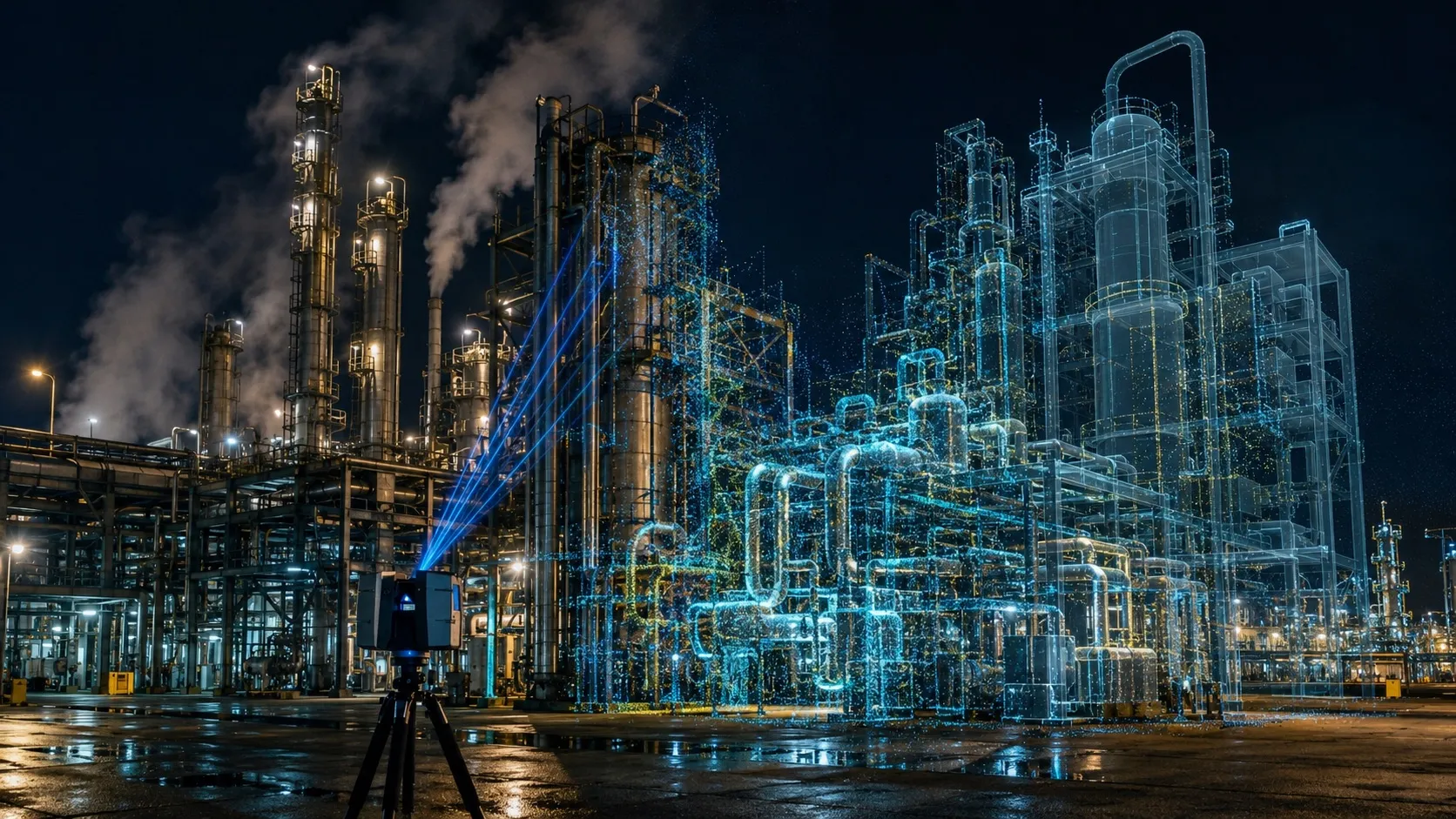
Oil & Gas
Our team delivered a complete 3D virtual tour and BIM documentation of an operating refinery unit for one of the world's largest oil producers, enabling remote measurements and fewer field permits for subsequent engineering studies.
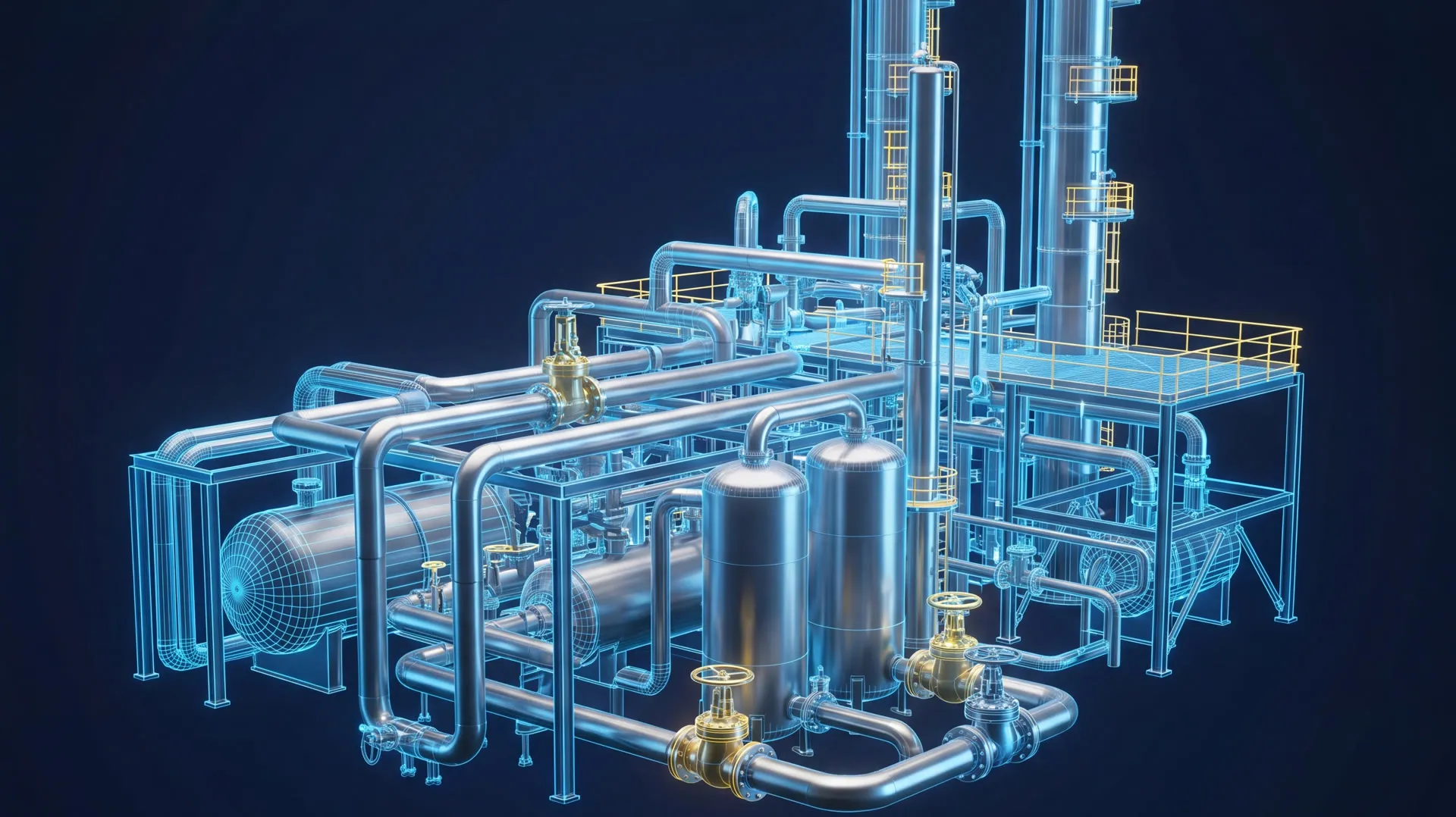
Your asset, as it really is.
Rysax builds living digital twins of industrial assets: millimeter-precise 3D replicas that your engineering, maintenance, and operations teams use to plan, decide, and act without guesswork.
Two words get used interchangeably in this industry, and the difference is the reason this page exists.
As-built is the record of how the asset was constructed, accurate on the day the contractor handed it over. As-is is how the asset stands right now. On a unit that has run for decades, those are different objects, and the second one is the only one that is true.
The distance between them was not carelessness. It accumulated one undrawn field fix at a time, each one somebody solving a real problem under production pressure. Nobody set out to lose the drawings. The asset simply moved and the paperwork did not.
That gap has a price: rework discovered mid-project, failed tie-ins, schedule slips, shutdowns that run long, and field crews sent to verify what the documentation should already know.
Decisions are only as good as the data behind them. And on most sites, the data is years out of date.
Here is the honest version of what capture can do, and it is worth saying plainly because most vendors will not. On an asset that has been running for years, nobody can hand you as-built anymore. That record described a unit that has since moved. What we can give you is as-is, measured, and on a running asset that is the version every decision depends on.
And where an asset genuinely has not moved since handover, as-is and as-built are the same document. If that is your situation, we will tell you so, rather than sell you a gap that is not there.
A Rysax digital twin is a precise, navigable 3D replica of your physical asset as it stands today, built from laser scanning and engineered into intelligent as-is models. But the model is only the beginning.
What makes a twin living is what it does after delivery: it becomes the single source of truth your teams consult before every intervention, and the foundation that powers AI-driven coating intelligence, faster field inspections, immersive training, and simulation of the operations you cannot afford to get wrong.
Scan-to-BIM is a deliverable. A living twin is an operating advantage.
And a living twin keeps growing, in directions well beyond our portfolio. It is the natural foundation for IoT and real-time operating data, process simulation, predictive maintenance models, and autonomous inspection. We build in open formats precisely so your twin can take any of those paths. With us, or without us.
Survey-grade laser scanning, with the right instrument for each job. When millimeters matter, our field crews scan with FARO Focus Premium terrestrial scanners: ±1 to 2 mm accuracy at 10 meters, up to 2 million points per second, capturing more than 3,000 points per square meter. When seeing the space matters, Matterport Pro3 captures immersive, navigable walkthroughs your whole team can open in a browser. And when a project calls for aerial coverage, we deliver it through certified drone partners (imaging and LiDAR), integrated into the same deliverable. Either way: safe, fast, and with minimal disruption to operations.
Our engineering team converts point clouds into intelligent 3D models and BIM with millimetric precision, in the platforms your engineers already use: AVEVA, Autodesk (Navisworks, ReCap, Revit, AutoCAD, Civil 3D, Inventor), and SolidWorks. Our global production team works your business hours, which means same-day collaboration and revisions, not overnight turnarounds.
Your twin goes to work: design-versus-reality comparison, current documentation, shutdown planning, remote measurements, virtual tours. And when you are ready, AI inspection, VR training, and simulation built on top.
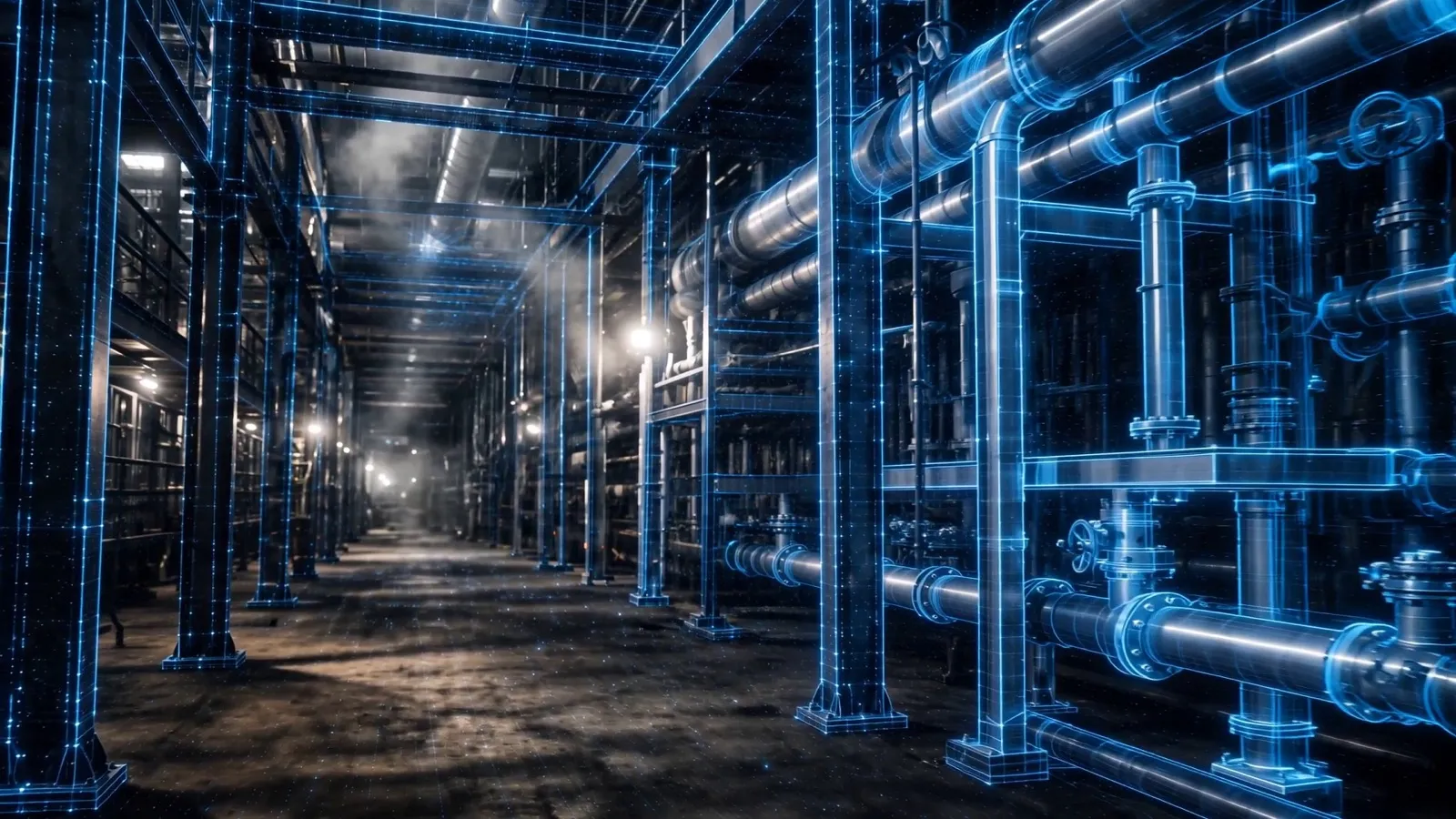
Oil & Gas
Our team delivered a complete 3D virtual tour and BIM documentation of an operating refinery unit for one of the world's largest oil producers, enabling remote measurements and fewer field permits for subsequent engineering studies.
Metals & Steel
For a global steel leader, our team laser-scanned critical processing equipment and updated 3D models that had drifted decades out of date, closing the gap between documentation and the asset as it actually runs.
Logistics & Terminals
For a global terminal operator, our team built an as-is 3D model of a storage tank that fed into the structural analysis behind its safe-operation report.
Plenty of companies have invested in digital twins and seen nothing back. The pattern behind those failures is well documented, and it is rarely the technology. It is program design. Here is what goes wrong, and what we do differently.
We would rather scope small and prove value in ninety days than sell a three-year everything-twin.
Here is the fact that frames this page: the twin is the multiplier. Each Rysax solution pays for itself on its own. Connected through a living twin, they stop being separate tools and become a system. Every inspection updates the same picture of the asset. Every finding lands in context. Every training scenario reflects the site as it is today. That compounding is where the largest returns live.
But a multiplier is not a prerequisite. Every solution below delivers value from day one, with or without a twin:
Start where it hurts most. Every step plugs into the twin, and the twin makes every next step worth more.
If you are an EPC or project team looking for high-quality laser scanning, 3D modeling (as-built for new construction, as-is or as-found for anything already running, or BIM), brownfield surveys, aerial capture, or 3D animations, we run a dedicated services operation for exactly that, with the same instruments, the same engineers, and quotes that come back quickly.
Explore Scanning & Modeling Services →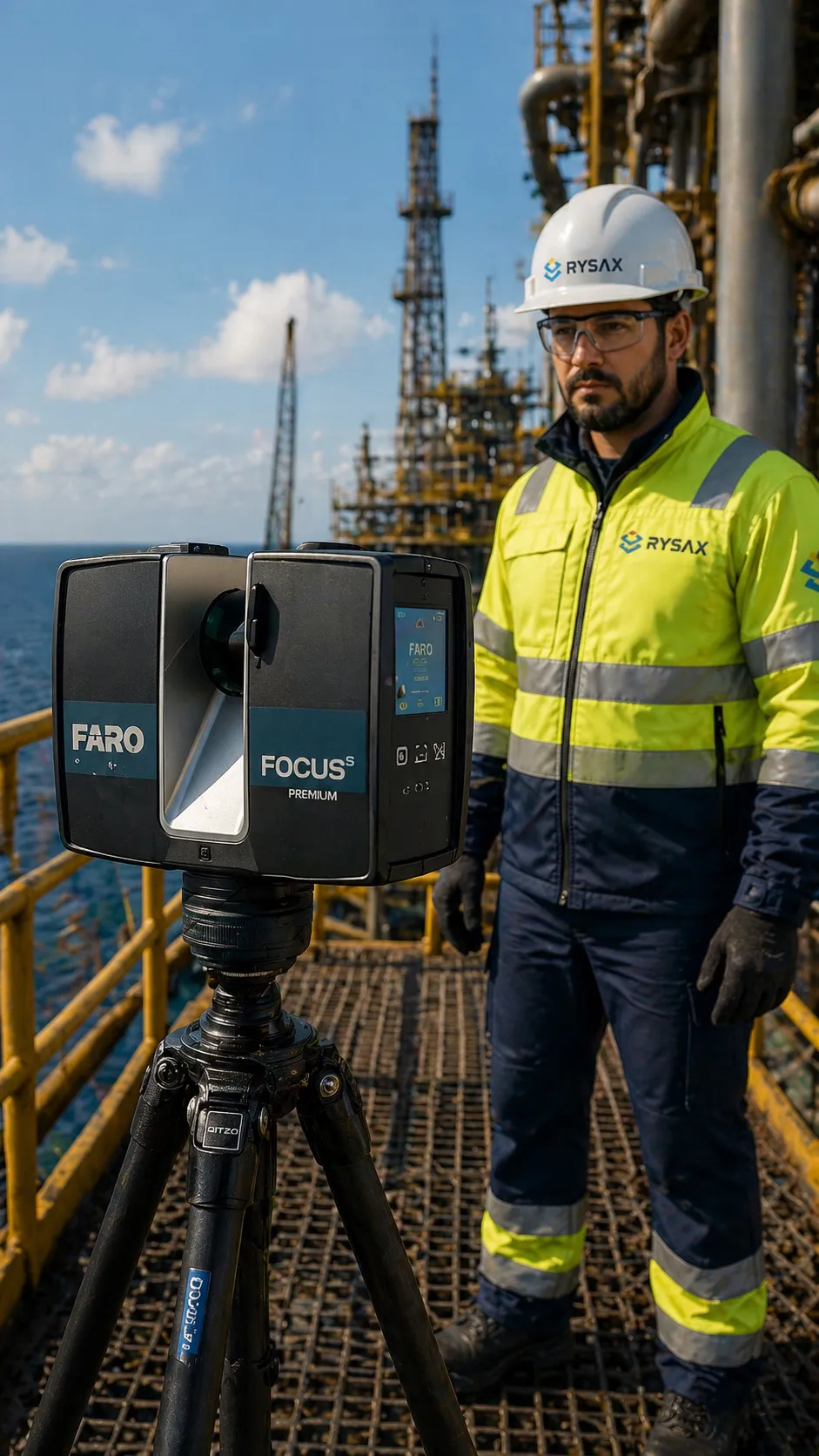
Laser scanning captures your site as a point cloud: millions of measured points with precise X, Y, Z coordinates. A digital twin is what that data becomes: an intelligent, navigable model of your asset that teams use for engineering, planning, inspection, and training. Scanning is the capture. The twin is the working asset.
Usually as-is, and the distinction matters. As-built describes how the asset was constructed on handover day. As-is describes how it stands now, after every modification the field made and the drawings never recorded. On a unit that has been running for years those are different objects, and as-is is the one your decisions depend on. On a recently built or tightly controlled asset they can still be the same document, and we will say so. We also deliver true as-built modeling for new construction, where the record and the reality have not had time to part company.
Capture time depends on the area's size, its congestion, and the scope of work, and it is far faster than conventional survey methods in every case. Modeling time depends on scope and the level of detail your project requires. Because our production team operates in your business hours, you see progress continuously instead of waiting for a final delivery.
No. Laser scanning is non-intrusive: it measures without physical contact with the asset, and it is performed safely inside operating sites. Our crews are experienced in live industrial environments and work around your operational constraints, with safety first.
Yes. We scan the site, compare the point cloud against your existing models and drawings, and reconcile the documentation, whether it was produced in-house or by another vendor. You get documentation that matches the field, fully updated, without starting from zero.
AVEVA, Autodesk (Navisworks, ReCap, Revit, AutoCAD, Civil 3D, Inventor), SolidWorks, and other major engineering platforms, in the formats your technical team already uses. You own the data.
It depends on the asset's size and the level of detail and intelligence you need, which is why we scope every twin against your goals rather than a standard package. What we can tell you before any conversation: the scope is defined with you before you commit, it stays flexible as the project teaches you things, and the quote you approve comes without unpleasant surprises.
Usually, yes. Point clouds we did not capture go through a quality check by our technical team before production begins, and we build from them wherever quality allows. You should not pay twice for what you already own.
Talk to a specialist about your site, your documentation gaps, and what a living twin would change for your team. Real people, real engineers. No chatbots.