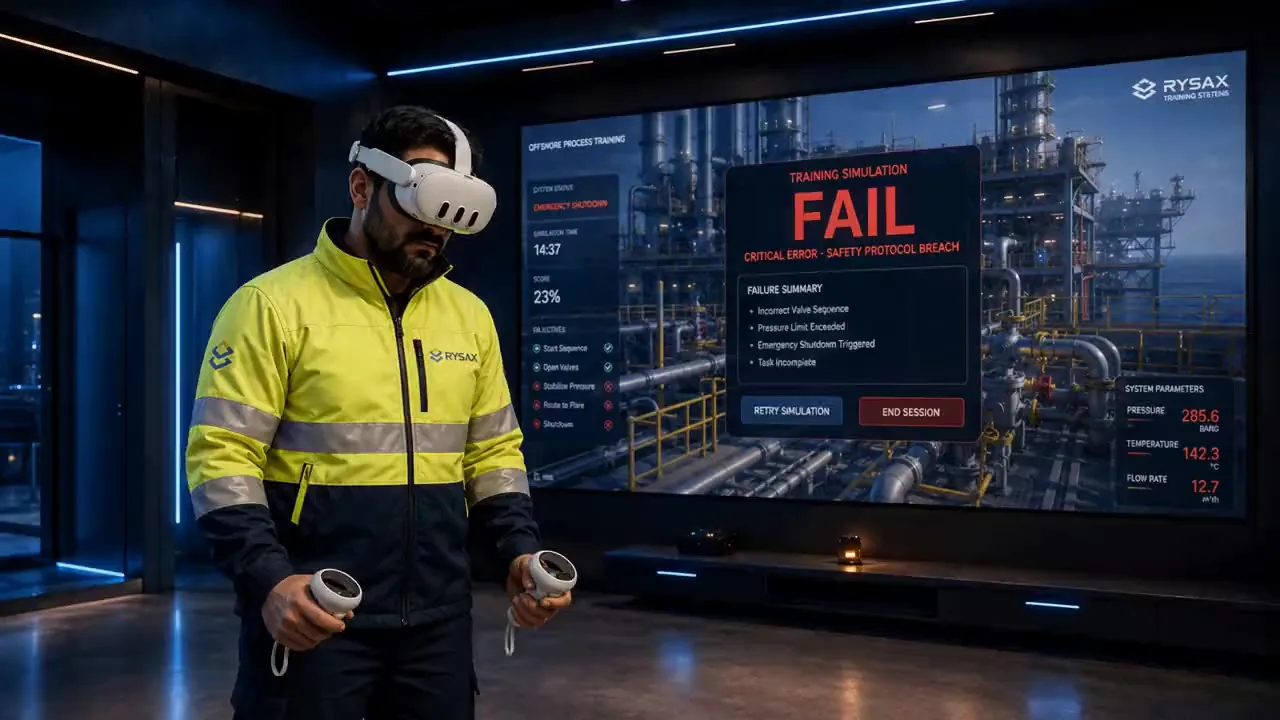
Why VR training projects fail, and how to design against it
The technology almost never kills these projects. The structure of the deal does. Seven failure modes we have watched the industry repeat, and the design decision that defeats each one.
Opening
Industrial Virtual Reality training has passed the proof stage.
Peer-reviewed research finds that immersive training is comparable to or superior to traditional methods in aviation, surgery, and assembly work, with reduced error rates (Frontiers in Virtual Reality, 2021). PwC's controlled enterprise study found that VR learners trained up to 4 times faster than classroom peers and were 275% more confident applying what they learned. The question in 2026 is not whether VR training works. It is why so many VR training projects still end as headsets in a cabinet.
Having built simulators for some of the hardest operating environments in heavy industry, including the continuous casting simulator our team developed in partnership with Ternium that won Worldsteel's 2023 Steelie Award for Excellence in Education and Training, we have seen the failure patterns up close, in prospects who came to us after a first attempt died. The patterns repeat. Here they are, with the design decision that defeats each one, so you can interrogate any proposal, including ours.
Failure 1. Pilot purgatory
The most common death is not a failure at all, on paper.
The demo impressed leadership, 10 headsets were bought, 1 scenario was built, and everyone applauded. Eighteen months later, the program has not grown, the headsets are in a drawer, and nobody can say who owns year two. Industry analysts consider this stall between pilot and program the single most significant failure outcome for enterprise immersive technology and note that the barriers are usually organizational rather than technical (AR Insider, 2024).
The root cause is that the pilot was designed to prove the technology works. Whether the technology works should never have been the question.
Design against it: make the pilot phase one of a program, not a science experiment. The success criteria have to be scale criteria, the ones that tell you whether this can become a program: cost per trained professional, time-to-competency relative to a baseline, and feasibility across sites. And the commercial structure has to carry a path from pilot to program that does not require going back through procurement, because a program that has to be bought twice usually gets bought once.
Failure 2. The technology came before the learning objective
Some organizations buy VR because Virtual Reality is exciting, then go looking for something to train. Content gravitates toward what is easy to simulate rather than the competency gaps that cost money: abnormal-situation response, permit-to-work discipline, startup and shutdown sequences, and the procedures that produce incidents when they go wrong.
Design against it: start from an operational metric and a definition of "ready for the job," written down before anything is built. If nobody can state what a trainee should be able to do after the module that they could not do before, the project is decoration. The senior operators who own the tribal knowledge belong in the scenario-selection room, not just the review meeting. That knowledge is leaving on a schedule: US manufacturing expects about 2.8 million retirements within the decade (Deloitte and The Manufacturing Institute, 2024), and roughly one in four workers in US heavy industry is already 55 or older (BLS, 2025).
Failure 3. Nothing was measured, so nothing can be defended
The program runs, people report it is engaging, and at budget time it loses to line items that have numbers. Without a pre-training baseline and a defined readiness standard, even a working program cannot prove it works. The waste is doubled because VR generates richer assessment data than any other training modality: every decision, hesitation, and error a trainee makes in the simulator is measurable.
Design against it: capture the baseline before deployment (incidents, errors, time-to-competency), define what score constitutes "qualified for the job," and use the simulator's own scoring against that standard for each professional, with records that withstand audits. If a vendor's platform does not measure readiness, ask exactly what the executive presentation will include.
Failure 4. The headset is the easy part to buy
The budget covered devices and one round of content.
It did not cover instructional design, updates, managing a batch of devices, IT security review, or year two. The program starves mid-life. The expensive part of a training program is not the hardware you buy. It is everything that keeps the program alive after launch, and that part recurs. What decides the business case is not the year-one sticker: it is how many people train, at how many sites, on how many procedures, and for how many years.
Design against it: model three years, or five, not one, and size the program honestly: learner count, sites, scenario count. Then structure the scope so the numbers work. The quieter version of this failure is a program nobody specified properly, because cost balloons when the scope never says what the simulation has to reproduce and to what standard. What drives behavior is fidelity on the dimensions that matter: procedure logic, instrumentation, failure response. A disciplined scope is what makes the training accurate, and it is what makes the price defensible.
Failure 5. The simulator went stale
In heavy industry, procedures may change, and skills must evolve.
A simulator built as a one-off capital project drifts out of sync with the unit, and a simulator that trains an outdated procedure is not helpful: researchers call it negative transfer, the trained reflex that is now the wrong reflex (Frontiers in Virtual Reality, 2021). Hardware drifts the same way: headset generations turn over fast, and content locked to a discontinued device expires with it.
Design against it: content currency has to be structural rather than aspirational. Modular scenarios mapped to individual procedures, so a change affects one module rather than the whole simulator. A contractual update path, written before signature, that says who updates what and at whose cost. Someone in operations who owns flagging procedure changes to the training team, by name. And a commercial model that includes keeping content and platform current, whether that is charged as a subscription or as support and maintenance, because an update that needs fresh approval every time tends not to happen.
Failure 6. The change nobody managed
Three versions of the same failure, and not one of them is technical.
The logistics: what works with five headsets collapses at thirty across three sites, with charging, hygiene, firmware, device management policy, and an IT security team that first hears about the headsets at rollout. The first session: a professional who has never used VR may feel motion sickness at first, be exposed, and quietly never come back. And the one that kills more programs than either of them, because it rarely gets discussed at all: nobody protected the time. Supervisors are measured on output, not on training hours. A program with no hours in the shift plan competes against production every day, loses every day, and gets written up afterward as a technology that did not catch on.
Design against it: treat the rollout as change management, because that is what it is. Bring IT security in before procurement, not after. Name a device owner per site or site area. Engineer the first session deliberately: short, guided, low-stakes, with comfort options and a way out that costs nobody their dignity. Include the training hours in the shift plan and set a target that includes them, so nobody is asked to choose between training and their numbers. And where immersion is not required, do not require it: a desktop version of the same scenarios reaches people who do not need a headset, those who cannot tolerate one, and sites whose device logistics are not ready yet.
Failure 7. It was sold as replacing trainers, and the workforce heard it
VR oversold as replacing classroom, mentoring, and on-the-job training fails twice.
It fails against an impossible bar, because tactile skills and real-equipment judgment still need the field. And it fails politically, because the frontline hears the ROI pitch as job replacement. As one aerospace technologist put it at an industry panel: front-line workers do not care about unit economics (AR Insider, 2024).
Design against it: blend, and say so. VR takes the scenarios you cannot practice on live equipment: the compressor trip, the furnace flameout, the emergency that has thankfully never happened. Classroom, mentoring, and field time keep their roles. Structurally, put the senior trainer inside the simulation: instructor-controlled scenarios where the veteran injects failures and escalates situations live. Make your most experienced people the authors of the program instead of its casualties. The message to the workforce then writes itself, and it happens to be true: this exists so you go home whole.
Before you sign anything
A short list of interrogation questions for any VR training proposal, ours included.
What operational metric defines success, and what baseline captures it? What does "ready for the job" mean, in writing? What happens after the pilot, without re-procurement? What does year three cost, including updates? What happens when the procedure changes? When is the headset model discontinued? Who runs the first session, and what happens to the trainee who cannot wear a headset? And who, by name, owns this program when its sponsor gets promoted?
Any vendor who welcomes those questions is worth talking to. Any vendor who dodges them has already answered.
Where we stand on all of this. Everything above is how we would judge any vendor, so it is only fair to say how it applies to us. We sell tiers under subscription rather than one-off builds, so moving from a proven pilot to a program is a budget line and not a new procurement. Keeping scenarios current as procedures change, and keeping simulators running as headset generations turn over, sits inside that subscription. Every tier includes a Windows desktop version of the same training, so the program reaches people the hardware does not. And from Tier 3 up, instructors control the simulation live. None of that makes us the right answer for your operation. It does mean that when you ask us the questions on this list, there are answers.
Design the program before you buy the technology.
Talk to a specialist who has built simulators for the world's hardest operating environments, or start with the numbers: our cost guide and Investment Guide provide structure for every question above.